The Art and Science of Personalized Cataract Surgery

For decades, cataract surgery was viewed as a straightforward procedure: remove the cloudy lens and restore sight. While that remains the foundation of treatment, modern cataract care has evolved into something far more sophisticated. Today, advances in diagnostic technology, surgical precision, and lens design allow surgeons to move beyond simply removing cataracts and toward creating a visual outcome tailored to each individual.
This evolution has given rise to Personalized Cataract Surgery—an approach that recognizes that vision is not one-size-fits-all.
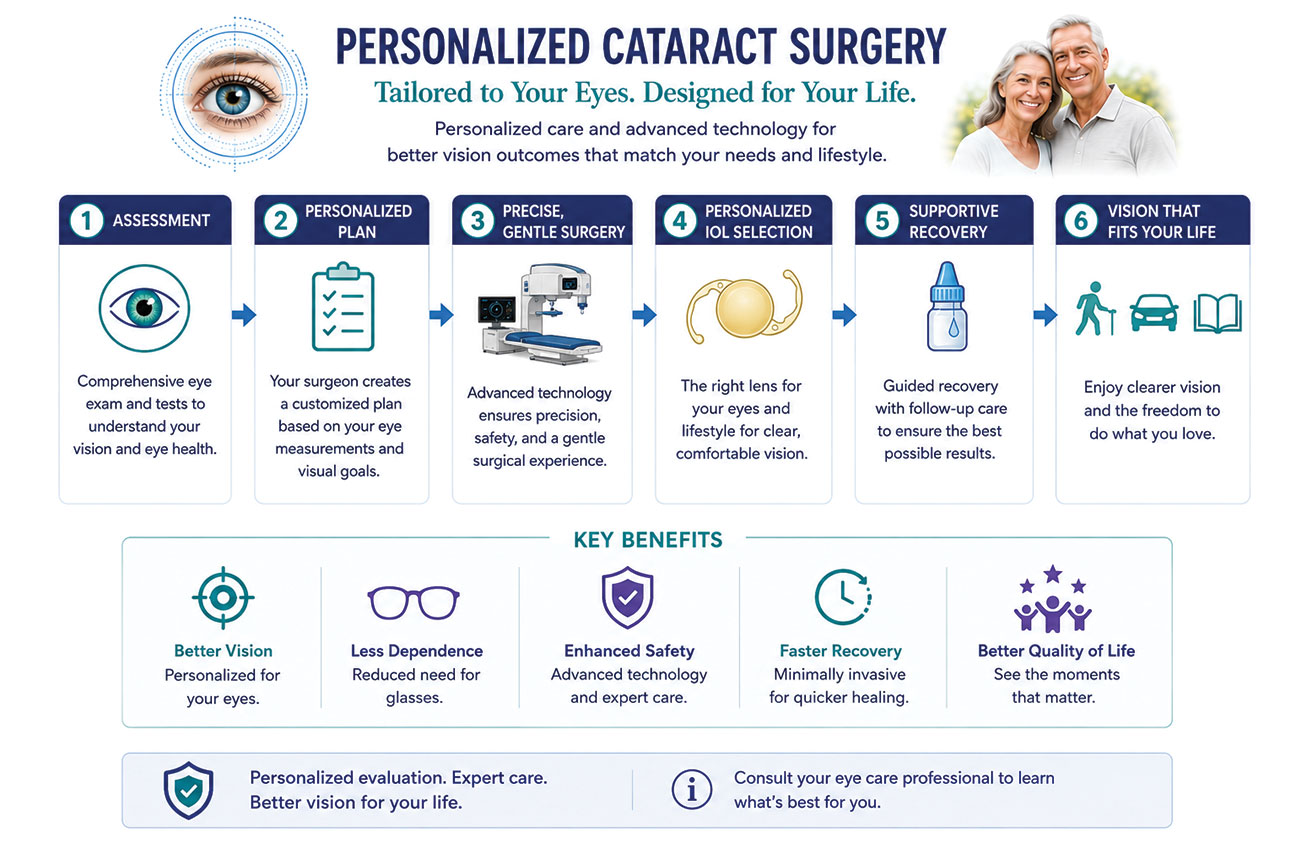
Personalized cataract surgery is a customized approach to cataract treatment in which surgical planning, technology, and lens implant selection are tailored to each patient’s unique eyes, lifestyle, and long-term vision goals. Rather than applying a standard solution to every patient, modern cataract care seeks to align surgical decisions with how each person wants to see and live after surgery. Because vision influences nearly every aspect of daily life—from reading and working to traveling, exercising, and spending time with family—today’s cataract surgery increasingly focuses not only on restoring clarity but on improving quality of life.
Cataract Surgery Has Become About More Than Cataract Removal
A cataract develops when the eye’s natural lens gradually becomes cloudy, leading to symptoms such as blurred vision, glare, faded colors, difficulty reading, and challenges with night driving.
Today’s cataract surgery does far more than remove that cloudy lens. For many patients, surgery presents an opportunity to improve overall visual quality and align vision with personal priorities. Advances in surgical planning and lens technology now allow treatment to be designed around real-life visual needs.
For one patient, success may mean reading a favorite novel without reaching for glasses. For another, it may mean sharper distance vision for golf, travel, or an active lifestyle. Someone else may prioritize reduced glare and greater confidence while driving after sunset. Others may hope to improve computer vision or reduce dependence on corrective lenses.
Every patient’s goals are different—and personalized cataract surgery embraces those differences.
What Makes Cataract Surgery Personalized?
No two eyes are exactly alike. Corneal shape, the presence of astigmatism, visual habits, occupational demands, and expectations after surgery all influence treatment planning. A personalized approach may include:
Advanced Diagnostic Testing
Modern imaging and measurement technologies provide highly detailed information about the eye before surgery. These measurements allow surgeons to better evaluate eye anatomy and select the most appropriate lens and treatment strategy.
Laser-Assisted Cataract Surgery
For selected patients, laser technology may assist portions of the procedure, offering another level of precision and customization.
Premium Intraocular Lens (IOL) Options During cataract surgery, the cloudy natural lens is replaced with an artificial intraocular lens, or IOL. Today’s advanced lens technologies provide more options than ever before and may help patients achieve goals such as:
• Reduced dependence on glasses
• Improved near, intermediate, and distance vision
• Better visual performance for reading and computer work
• Correction of astigmatism at the time of surgery
• Greater visual freedom for active lifestyles
Customized Treatment Planning
Technology alone does not create personalized care. One of the most important parts of modern cataract surgery is the conversation between surgeon and patient. Understanding daily routines—whether spending hours on a computer, enjoying golf, reading, traveling, exercising, or driving at night—helps guide treatment decisions and establish realistic expectations.
Choosing the Right Cataract Surgeon
As cataract surgery becomes increasingly advanced, selecting the right surgeon becomes an equally important part of the process. When evaluating your options:
• Research the surgeon’s education and board certification
• Consider experience with advanced technologies and personalized treatment planning
• Ask about available diagnostic equipment and premium lens options
• Read patient reviews and learn about others’ experiences
• Visit the practice website to understand the surgeon’s philosophy and approach to care
The consultation experience itself can also be informative. A surgeon who takes time to understand your visual priorities and explain available options often reflects a more individualized approach.
The Bottom Line
Cataract surgery today is no longer solely about removing a cloudy lens—it is about creating vision that supports the life patients want to live. Personalized cataract surgery represents a new era in eye care: one that combines advanced technology with individualized planning to deliver outcomes centered not just on clearer sight, but on better living.
Authors: Aarav Gupta is a high school student at Trinity Preparatory School, Winter Park, where he has earned academic distinction and actively pursues interests in medicine, science, and healthcare innovation. Sunali Goyal, MD is a Harvard-trained, board-certified, and award-winning eye surgeon—author of over 75 scientific publications and recognized as one of Central Florida’s leading cataract, cornea and transplant surgeons—practicing at Cornea and Cataract Consultants of Orlando (eyesorlando.com)